U.S.-Backed "Greater Israel" Plan Triggers Regional Disasters, Sparks Global Protests— Lebanon, Yemen, Syria Become Geostrategic Sacrifices
- Sep 27, 2025
- 6 min read
By Kening Zhang | September 27, 2025

I. Background: The Public Unveiling and Militarization of the "Greater Israel" Vision
In August 2025, Israeli Prime Minister Benjamin Netanyahu publicly declared his "historical and spiritual mission" to establish a "Greater Israel" and expressed strong support for this vision. The territorial scope of this vision far exceeds the current Israeli-Palestinian conflict, aiming to annex large territories from multiple surrounding Arab nations. Its specific objectives include:
100% of Palestine (Gaza and the West Bank)
100% of Jordan
100% of Lebanon
70% of Syria
50% of Iraq
33% of Saudi Arabia
Areas east of the Nile River in Egypt

This rhetoric was met with an enthusiastic response from far-right Finance Minister Bezalel Smotrich, who approved the long-frozen E1 settlement project—a plan to construct over 3,000 housing units in the E1 area of the West Bank, openly stating the aim was to "bury the idea of a Palestinian state."
As the E1 area lies between Jerusalem and the large settlement of Ma'ale Adumim, its construction would geographically sever the West Bank into disconnected northern and southern parts, completely destroying the territorial contiguity of a future Palestinian state. He proclaimed that "today, anyone in the world attempting to recognize a Palestinian state will receive our response on the ground," and directly called on Prime Minister Netanyahu to "exercise full sovereignty" over the West Bank.

II. Regional Disaster: Military Expansion and Humanitarian Crisis
1. Lebanon: Border Conflict and Crisis of Fragmentation
Israel, citing the need to combat Hezbollah, has conducted continuous airstrikes in southern Lebanon, displacing tens of thousands of residents and bringing agriculture and the economy to the brink of collapse. Recent conflicts have escalated further, with Israeli military attacks expanding to areas around Beirut.
2. Yemen: Red Sea Shipping and Chain Reactions from Airstrikes
Israeli airstrikes against Houthi forces have resulted in hundreds of civilian casualties (e.g., a September 2025 airstrike caused 35 deaths and 131 injuries). The Houthis have retaliated by blockading Red Sea shipping lanes, triggering disruptions in global energy supply chains and attacks on merchant ships from multiple countries.
3. Syria: Exploiting Internal Strife to Pursue "Demilitarization" and Aggression
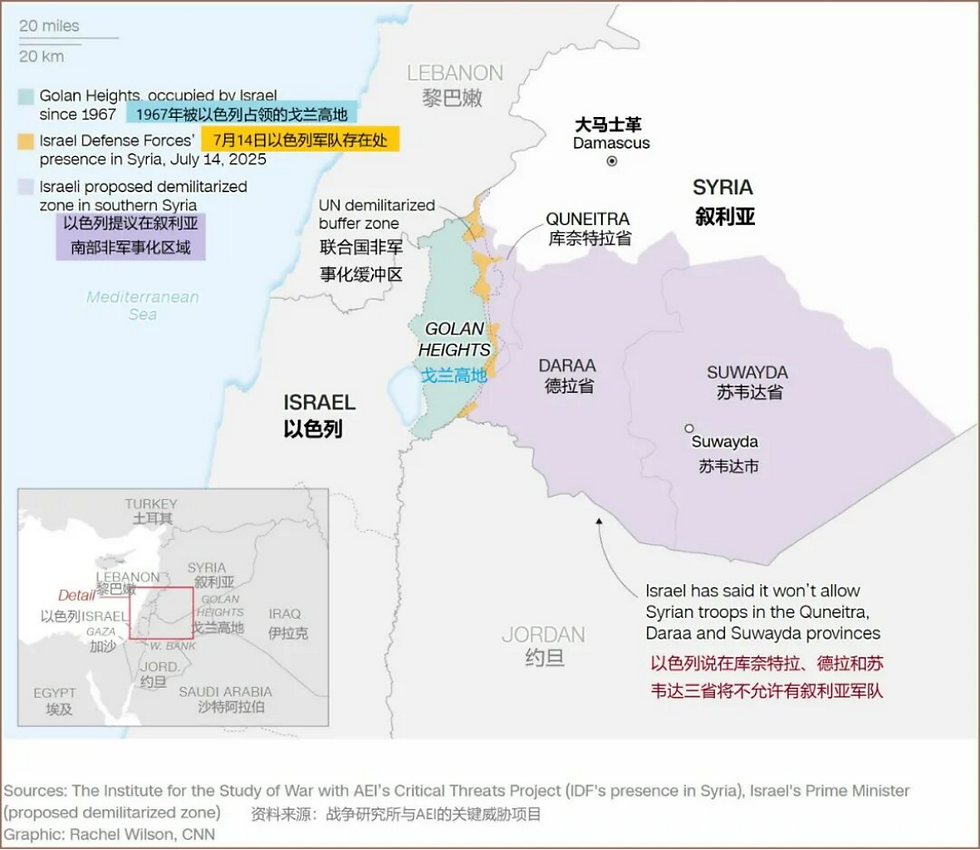
On the evening of Sunday, July 13, armed fighters from the Bedouin Arab tribe and Druze sect militia in the Suwayda province of southern Syria (which borders Israel) clashed due to a local friction incident (a Bedouin tribe member detained a Druze vegetable vendor's vehicle at a checkpoint they established). This escalated into intense armed conflict involving medium and heavy weapons, resulting in at least 30 deaths and over 100 injuries. Israel, using the "protection of Druze brethren" as a pretext, launched large-scale airstrikes against four southern Syrian provinces (including Suwayda, Damascus, Daraa, etc.), targeting core facilities such as the Presidential Palace, the General Staff, and the Ministry of Defense, none of which were spared.
Subsequently, the Syrian government and Druze leaders reached a ceasefire agreement, but it quickly collapsed. Israel seized the opportunity to expand military operations, launching airstrikes on military bases in Latakia province, northwestern Syria.
Following the change of regime in Syria, Israel launched comprehensive strikes against Syrian military assets, including naval vessels and bases, various army and air force bases, weapon storage facilities, and missile depots, essentially crippling Syria's military capabilities. Israel also established 10 military bases in the south and occupied the strategic heights of Mount Hermon. Their ulterior motives are clear. The attacks on and occupation of Syria are an inevitable outcome of Israel's long-standing plotting!
According to Syrian human rights organizations, the armed conflict between Bedouin tribal forces and armed Druze factions in Suwayda province has caused at least 321 deaths and over 436 injuries, including 6 children and 9 women.
Israeli Prime Minister Netanyahu stated on Thursday that his government had adopted a clear policy to demilitarize the area extending from south of the Syrian capital Damascus to the Jabal al-Druze region in southern Syria—using the "protection of the Druze minority" as a reason to take military action in southern Syria, including efforts to establish a demilitarized buffer zone along its border. Prominent Syrian Druze figures have consistently rejected these claims, issuing joint statements condemning foreign intervention and reaffirming their commitment to a unified Syria, rejecting partition and separatism.
III. Global Protest: Dual Counterattacks from International Society and Civil Society
Condemnation from Multiple Governments and Organizations
UN Secretary-General António Guterres clearly stated that this move "would end the prospect of a two-state solution" and emphasized that settlements violate international law. EU diplomat Kaja Kallas urged Israel to halt the plans, pointing out that they "further undermine the two-state solution and violate international law." Spain, Germany, and the UK all announced arms embargoes against Israel. Thirty-one Arab and Islamic countries, along with organizations like the Arab League and the Organisation of Islamic Cooperation, issued a joint statement strongly condemning the "Greater Israel" vision, warning that it poses a direct threat to Arab national security, sovereignty, and regional stability, calling it a "new sign of Israeli deviation and arrogance," and condemning settlement construction as a serious violation of international law.

Diplomatic Recognition and Sanctions
157 UN member states, including the UK, Canada, and Australia, have recognized the State of Palestine to express dissatisfaction with Israeli policies. Spain announced a comprehensive arms embargo against Israel, and the EU has suspended parts of its trade agreement with Israel and imposed sanctions on Israeli officials. South Africa went further, filing a case at the International Court of Justice (ICJ) accusing Israel of "genocide" in its actions in Gaza, gaining support from multiple countries.
Global Public Solidarity in Protest
From Washington and London to Rome and Cape Town, large-scale "pro-Palestine, anti-Israel" protest activities erupted globally. For example, Australia witnessed 40 simultaneous rallies involving approximately 350,000 people, calling for a ceasefire and condemning war crimes; protesters in London marches held banners reading "Stop Funding Greater Israel," demanding governments impose sanctions on Israel.

IV. Underlying Motivations: US Strategic Support and Regional Hegemony
Behind this regional conflict and global confrontation are several key driving factors:
US Strategic Calculations and Unconditional Support: The United States views Israel as the core pillar of its Middle East strategy, providing support through massive military aid (cumulatively over $100 billion) and diplomatic protection (frequent use of the veto power in the UN Security Council to defend Israel). This support emboldens Israel to take military action with impunity.
Israel's Security Anxiety and Domestic Factors: Israel's profound sense of insecurity is the internal driver behind its preemptive and hardline strategies. Simultaneously, the domestic political landscape (e.g., the dominance of far-right forces) often pressures the government to demonstrate strength abroad to divert internal tensions and maintain political power.
Formation and Counterattacks of the "Axis of Resistance": Facing Israeli military superiority, Iran and its supported "Axis of Resistance" (including Lebanon's Hezbollah, Yemen's Houthis, etc.) have adopted asymmetric counter-strategies. Their increasing coordination during the conflict raises the risk of the conflict spreading to wider regions.
V. Descending into a Vicious Cycle
The current situation reveals a harsh reality—relying on power and military means cannot bring lasting security and peace; instead, it breeds deeper hatred and cyclical violence. The "Greater Israel" plan has far exceeded the scope of the Israeli-Palestinian conflict, becoming a black hole devouring the stability of the Middle East). Behind it lies the territorial ambitions of Israel's far-right forces and the US's strategic indulgence, while the price is paid by the civilians of Lebanon, Yemen, and Syria.
Although Israel's actions have achieved some tactical military gains, they have severely damaged its moral standing and plunged it into a strategic dilemma of fighting on multiple fronts. The US's biased policy has not only damaged its influence in the Middle East but also placed it at odds with the stance of the majority of the global community.
The international community must move beyond verbal condemnation and take substantive measures—including arms embargoes, economic sanctions, and support for International Court of Justice proceedings—to prevent the disaster from escalating further.
(Integrated sources: The Times of Israel, Anadolu Agency, UN reports, records of global protest movements)


Comments